Washer Troubleshooting
Why Your Washer Won’t Drain (and What to Check First)
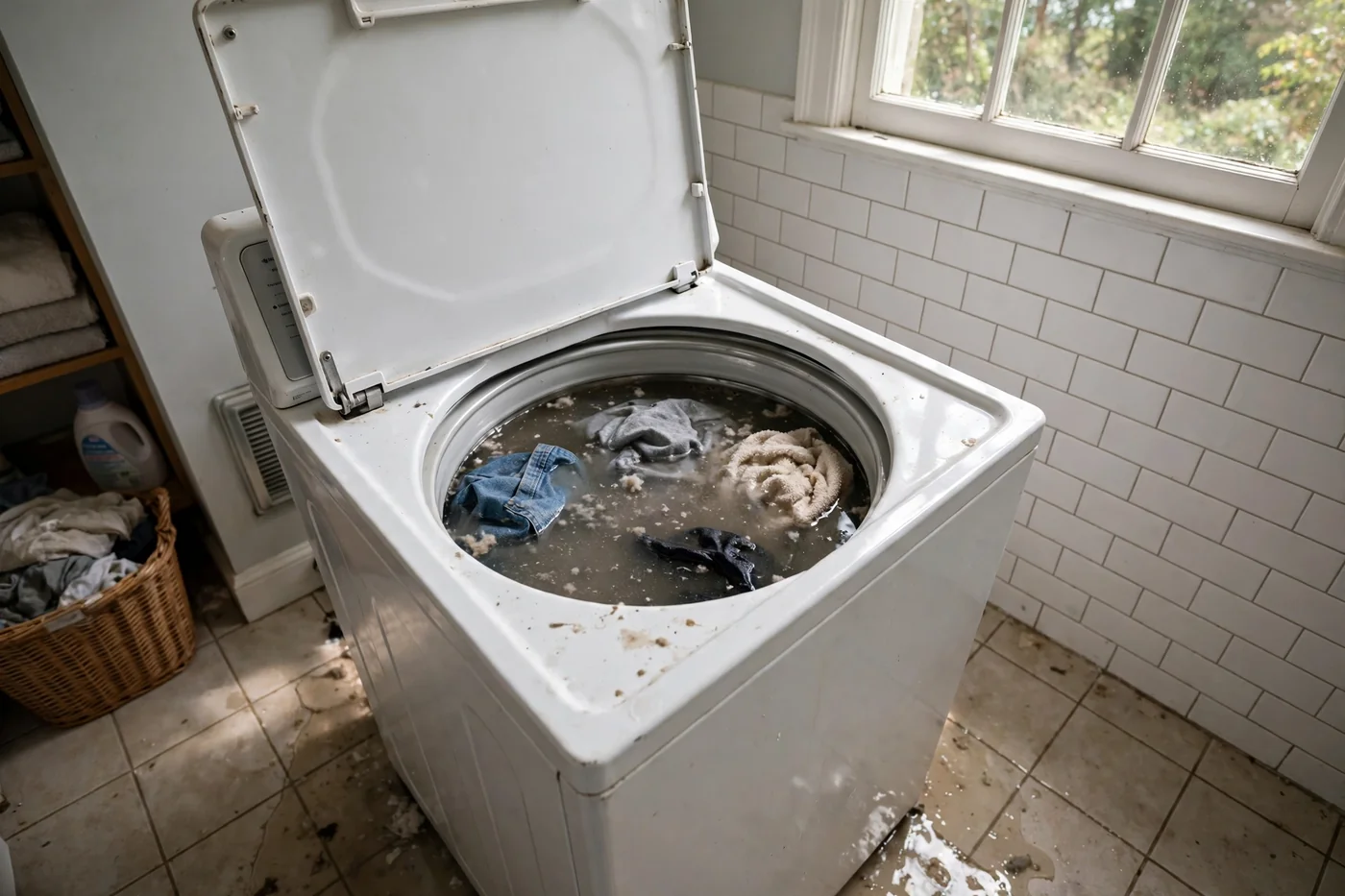
The first time my own washer quit on me, I stood in front of a tub of gray water and did everything wrong: I ran another cycle, which just added more water to the mess. Here is the calmer version I wish someone had handed me that night. Before you call anyone, there is a short list of things worth doing yourself, and they all use your hands, a bucket, and your eyes, not tools.
Make it safe, then bail the water out
Unplug the machine first. Reach for the plug, not the dial, and do it before your hands go anywhere near the water. Water and electricity do not mix, and you will be reaching around the machine in a minute.
Now grab a bucket. A big pitcher or a stockpot works too. Start bailing the tub down as far as you can. Getting the water level low does two favors: nothing sloshes across the floor when you slide the machine out, and you can actually see what you are doing around the back. Lay towels around the base of the washer, because some water always escapes. In Clarksville’s humid summers, a tub left sitting starts smelling within a day, so do not leave this job for the weekend.
Feel the hose for kinks
Slide the washer forward a few inches so you can reach behind it. Find the ribbed line that leaves the back of the machine and runs to the wall, then run your hand along its whole length. You are feeling for a flat spot where it got pinched, a sharp fold, or a section squashed between the machine and the wall. Check where it meets the wall pipe too: if it is shoved down too far, air cannot escape and the water has nowhere to go.
Straighten out anything you find, then ease the washer back so the line keeps a smooth curve. This one check resolves more stuck tubs than you would guess. It is the first thing I talk through on the phone with homeowners from New Providence to the subdivisions off Wilma Rudolph Blvd, and it fixes the machine about half the time.
Open the little door
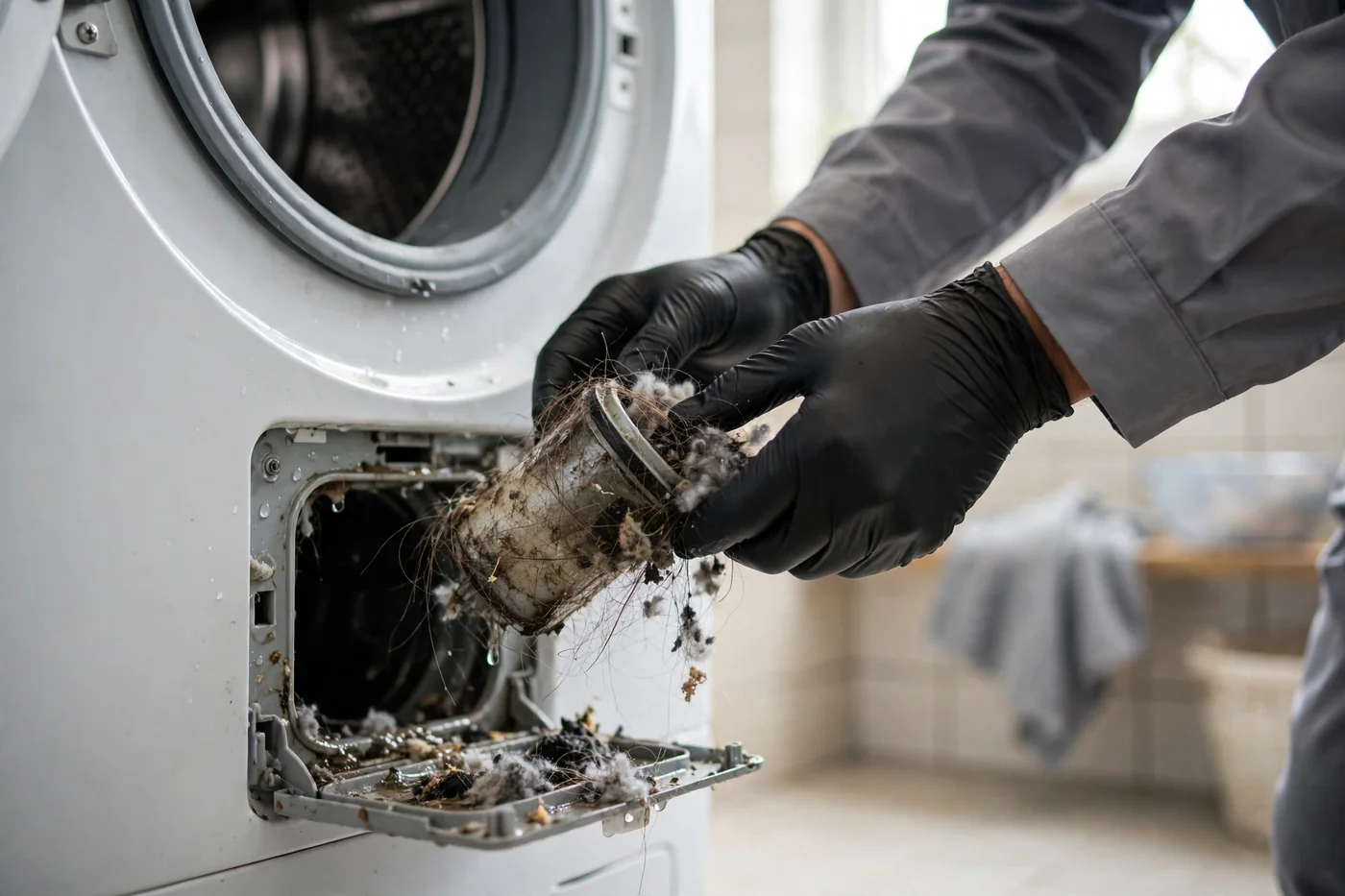
If you own a front-loader, look low on the front of the machine for a small rectangular door. Put a shallow pan and a towel under it before you touch anything, because water will come out when you open it. Twist the little screen inside slowly and pull it free, then pull out whatever has collected: lint mats, coins, hair ties, and in homes with kids, the occasional action figure.
What comes out tells you plenty. A packed screen explains the whole problem, and emptying it is a genuine fix, not a workaround. Top-loaders do not have this little door; their layout is different, so check your manual for where yours traps debris instead of guessing.
Press the little button and listen
Top-loader owners, this one is yours. Plug the machine back in, set it to spin, and find the little button or slot the cover presses down when it closes. Press it with a pen. If the machine wakes up and starts pushing water out, the button was your problem: the washer thought the cover was open and refused to move on.
While you are listening, pay attention to the sounds. A steady hum means the works are trying but something is still stuck in the path. Silence, or a grind like chewing gravel, is a different story, and that is where most homeowners hand the job over.
Don’t run “just one more cycle”
This was my original mistake, so let me save you from it. When the tub is full and the machine looks stuck, the temptation is to turn the dial and try again, hoping this time it finishes. All that does is add more gallons to a tub that already cannot empty itself. The machine is not confused; it is stopped for a reason. Bail the water, do the checks above, and let the machine sit quiet until you know what is wrong. Your floor will thank you.
The five-minute habit that prevents the sequel
Here is the part nobody wants to hear: the same tub can do this again next year if nothing changes. Once a season, I open that little door and pull the screen, even when the machine is running fine. It takes five minutes and it has saved me twice. I also stopped shoving the machine tight against the wall; it sits a few inches out now, with the line behind it in a smooth curve. Not pretty, but my weekends are prettier.
When I stop and pick up the phone
If the line is smooth and clear, the screen is clean, and the tub is still full, the trouble is deeper: the works inside, or the wiring and controls behind the panel. That is where my DIY story ends. Call us at (931) 208-9792 and tell us what you already checked; it saves us both time.
Call sooner if you smell anything burning, if water is seeping from under the machine, or if the washer is a stacked or built-in unit where reaching anything means moving cabinetry. And if you are renting near Fort Campbell and the machine came with the lease, loop in your property manager before anyone opens a panel. When in doubt, stop. I would rather talk you through a two-minute check on the phone than have you flood a laundry room.
Related reading
- Drain pump repair in Clarksville · what a pro visit looks like when you call
- Washer repair service in Clarksville, TN · same-day diagnosis for all washer problems
- How often should you service your washer and dryer? · the maintenance cadence that prevents clogs
Why does my washer stop before the spin cycle with water still in the tub?
Most washers won't spin until the water drains, so a full tub at spin time usually means the drain system never finished its job. The common causes are a clogged drain pump filter, a kinked or blocked drain hose, a failed drain pump, or a lid switch that never signaled the machine to move on.
Where is the drain pump filter on a front-load washer?
On most front-loaders it's behind a small access door on the lower front of the machine. Place a shallow pan and towels under it before you unscrew the cap, because water will come out. If you can't find an access door, check your owner's manual, and don't remove any cabinet panels yourself.
Can a kinked drain hose keep a washer from draining?
Yes. If the hose is pinched behind the machine, pushed too far down into the standpipe, or crushed where it meets the wall, the pump can't push water out. Straightening the hose is a safe, easy check and fixes more machines than you'd expect.
My washer hums but won't drain. Is the pump dead?
Not always. A humming pump is trying to work but can't move water, which often points to a clog rather than a dead motor: a sock, coin, or lint buildup lodged in the pump or filter. A silent pump with no hum at all points more toward an electrical issue like the lid switch or control, which is a job for a technician.
How much does it cost to fix a washer that won't drain?
It depends on the cause: clearing a filter or hose is quick, while a drain pump replacement is a bigger job. Our washer and dryer cost guide explains typical repair ranges, and we always give you a firm, upfront quote after diagnosis, before any work starts.